Medical Student Midwestern University/AZCOM Glendale, Arizona, United States
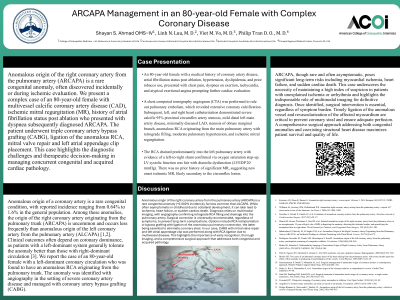
Clinical Scenario or Case: An 80-year-old female with a medical history of coronary artery disease, atrial fibrillation status post ablation, hypertension, dyslipidemia, and prior tobacco use, presented with chest pain, dyspnea on exertion, tachycardia, and atypical exertional angina prompting further cardiac evaluation.
Evidence/Literature Review: Anomalous origin of the right coronary artery from the pulmonary artery is a rare congenital anomaly with an estimated incidence of 0.002% in the general population. ARCAPA is significantly less common than its counterpart, ALCAPA, and is often discovered incidentally in adulthood, especially when coexisting with acquired heart disease. Embryologically, ARCAPA results from abnormal septation of the truncus arteriosus or involution of the proximal right coronary bud with persistence of a connection to the pulmonary artery. Although typically isolated, ARCAPA may be associated with other congenital cardiac anomalies such as ventricular septal defects, tetralogy of Fallot, or aortic arch malformations. There is no consistent genetic predisposition reported, but associations with congenital syndromes and familial clustering have been described in limited case reports.
Unique Aspects of Case: Recognition and surgical correction of ARCAPA are critical even when discovered incidentally, as untreated ARCAPA carries a significant risk of myocardial ischemia and sudden cardiac death. Timely diagnosis using multimodal imaging and an aggressive surgical approach addressing both congenital and coexistent acquired cardiac pathology leads to optimal patient outcomes.
Recommendations/Conclusions: ARCAPA, though rare and often asymptomatic, poses significant long-term risks including myocardial ischemia, heart failure, and sudden cardiac death. This case underscores the necessity of maintaining a high index of suspicion in patients with unexplained ischemia or arrhythmia and highlights the indispensable role of multimodal imaging for definitive diagnosis. Once identified, surgical intervention is essential, regardless of symptom burden. Timely ligation of the anomalous vessel and revascularization of the affected myocardium are critical to prevent coronary steal and ensure adequate perfusion.