Medical Student Nova Southeastern University Clearwater, Florida, United States
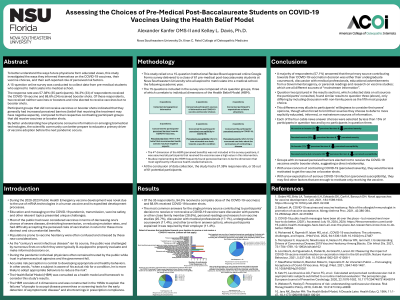
Introduction/Background: The worldwide risk of disease is increasing. Future physicians will help educate the public and motivate patients to adopt vaccinations and other public health measures. To better understand the ways future physicians form educated views towards innovative medical technologies, this study investigated the ways future physicians informed themselves on the COVID-19 vaccines and boosters, and their self-reported role of perceived risk factors. This study aims to better understand relationships between sources of information with vaccine choices and justifications of pre-medical students during the COVID-19 Public Health Emergency.
Methods: This study relied on a 15-question online survey to collect data from pre-medical post-baccalaureate students at Nova Southeastern University who aspired to matriculate into medical school. Statistical analysis of the data compared responses on individual and group bases.
Results/Discussion: The response rate was 57.38% (35/61 potential participants). 94.3% of respondents received the COVID-19 vaccine and 68.6% received booster shots. The most common answers for the primary source contributing to participants’ vaccine decision were discussion with parents or other close family member, personal readings and research on vaccine studies, discussion with medical professionals, undergraduate coursework, and being required by their employer.
Demographic data from the survey revealed 48.6% of participants were between 25-29 years old and 42.9% of participants were between 20-24 years old. 32 participants received the COVID-19 vaccine and 26 received COVID-19 booster shots.
Conclusions: Participants primarily relied on mainstream sources of education and/or personal relationships to develop decisions. The two participants who elected not to receive any COVID-19 vaccines or booster shots generally were not fearful of developing life-threatening infections and they may not have considered the vaccine in empathetic terms. The nine participants who elected to receive COVID-19 vaccines and not any booster shots were generally much less concerned about the health risks of receiving the COVID-19 vaccines.