Medical Student Nova Southeastern College of Osteopathic Medicine Fenton, Missouri, United States
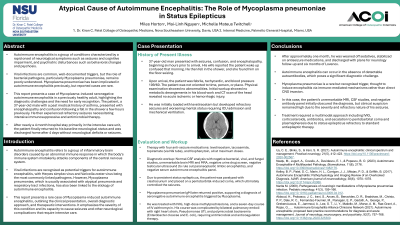
Clinical Scenario or Case: A 37-year-old man with a history of asthma presented to the hospital with confusion and new-onset generalized seizures. Initial labs showed leukocytosis and elevated inflammatory markers. Imaging was unremarkable, and cerebrospinal fluid revealed elevated protein without pleocytosis. Despite treatment with multiple antiepileptics, he remained in status epilepticus requiring intubation. Extensive infectious workup was unrevealing except for positive Mycoplasma pneumoniae IgM and IgG. After failing antibiotics alone, he was treated with IVIG and plasmapheresis for presumed Mycoplasma-induced autoimmune encephalitis, with gradual clinical improvement.
Evidence/Literature Review: While rare, in a few circumstances in the literature Mycoplasma pneumoniae has been implicated in neurologic complications. Both Kentab AY et al. and Ye Z et al. described pediatric cases of Mycoplasma-related encephalitis, many of which were antibody-negative and responded to immunomodulation. In a review by Narita, Mitsuo, Mycoplasma was linked to both direct invasion and immune-mediated neurological disease, especially in cases with minimal pulmonary symptoms. These reports support a post-infectious autoimmune process, often presenting with negative neuronal antibodies but responsive to IVIG or plasmapheresis when standard treatments fail
Unique Aspects of Case: This case highlights a rare presentation of new-onset refractory status epilepticus (NORSE) secondary to Mycoplasma pneumoniae. The absence of classic neuronal antibodies and failure of antibiotic monotherapy emphasize the autoimmune mechanism. The patient’s favorable response to immunotherapy supports early consideration of immune-mediated causes in similar clinical contexts.
Recommendations/Conclusions: Mycoplasma pneumoniae should be considered a potential trigger for autoimmune encephalitis in patients presenting with unexplained status epilepticus. This case reinforces the importance of evaluating for atypical and seronegative autoimmune causes in patients with refractory neurologic symptoms.