Student Orlando College of Osteopathic Medicine Lakeland, Florida, United States
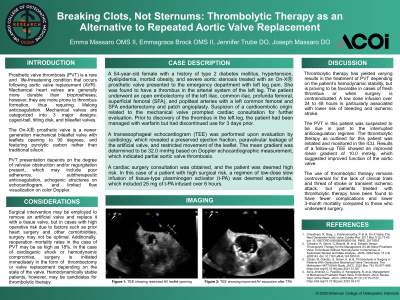
Clinical Scenario or Case: A 54-year-old female with a history of type 2 diabetes mellitus and severe aortic stenosis treated with an On-X prosthetic valve presented to the emergency department with left leg pain. She was found to have a thrombus in the arterial system of her left leg and underwent an open embolectomy of the left lower extremity. An echocardiogram performed upon evaluation by cardiology indicated partial aortic valve thrombosis, and the patient was deemed high risk for surgery upon cardiac surgery consultation.
Evidence/Literature Review: Prosthetic valve thrombosis (PVT) is a life-threatening condition that can occur following aortic valve replacement. Surgical intervention may be employed to remove an artificial valve and replace it with a tissue valve, but surgery may not be favorable in the case of a patient with high risk. Thrombolytic therapy has yielded varying results in the treatment of PVT depending on the patient’s hemodynamic stability, but it may be chosen in cases when surgery is contraindicated.
Unique Aspects of Case: Prior to discovery of the thrombus in the left leg, the patient had been managed with warfarin but stopped taking it for 3 days; this interruption of anticoagulation was suspected to have contributed to formation of the PVT. A regimen of low-dose slow infusion of tissue-type plasminogen activator (t-PA) was deemed appropriate for this patient, which specifically included 25 mg of t-PA infused over 6 hours.
Recommendations/Conclusions: There are no current guidelines suggesting thrombolytic therapy in the setting of prosthetic valve thrombosis, and the lack of clinical trials regarding this therapy calls for further research, especially concerning the risk of stroke or transient ischemic attack; however, the success of thrombolytic therapy for this patient with high surgical risk is promising.