Student West Virginia School of Osteopathic Medicine Herndon, Virginia, United States
Introduction/Background: Metabolic dysfunction-associated steatotic liver disease (MASLD) and obstructive sleep apnea (OSA) are highly prevalent, affecting a quarter of the global population and nearly one billion individuals, respectively. These conditions frequently co-exist due to shared risk factors such as obesity and insulin resistance, with hepatic steatosis present in up to 70% of individuals with OSA. Integrated care for MASLD and OSA remains limited, emphasizing the need to assess current interventions and explore osteopathic-led improvements.
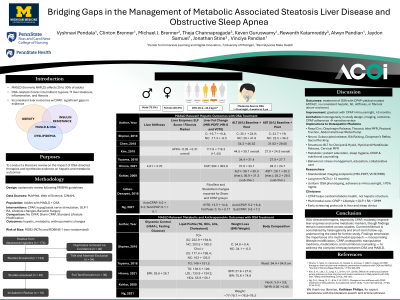
Methods: We used Preferred Reporting Items for Systematic Reviews and Meta-Analyses (PRISMA) guidelines to conduct a systematic review and screened 174 articles from PubMed, Web of Science, and Cumulative Index to Nursing and Allied Health Literature — published between 2009 to 2023. Eligible studies, included adults with MASLD and OSA, reported liver or metabolic outcomes following continuous positive airway pressure (CPAP), lifestyle modifications, glucagon-like peptide-1 (GLP-1) therapy, or bariatric surgery.
Results/Discussion: Eight studies (1,006 participants) were eligible, all focusing on CPAP therapy.
CPAP resulted in modest and inconsistent reductions in liver enzymes: ALT decreased by 4–8 U/L and AST by 2–4 U/L in select studies. Changes in liver stiffness were minimal (e.g., 4.6 to 4.7 kPa), and steatosis markers showed negligible improvement, with controlled attenuation parameter values remaining around 304 dB/m and intrahepatic triglycerides increasing slightly from 13.5% to 14.2%. Despite being standard for OSA, CPAP alone does not reverse hepatic dysfunction in MASLD–OSA population.
Conclusions: This review identifies a need for randomized controlled trials and early multimodal interventions in patients with both OSA and MASLD.
Integrating liver screenings into sleep clinics and OSA assessments in hepatology allows earlier care. OMT—diaphragmatic release, lymphatic pump, and suboccipital decompression—can benefit this population by improving respiration, lymph flow, and autonomic function.
Trials on lifestyle, GLP-1s, and bariatric surgery have not been conducted, leaving a critical gap in holistic treatment.