Internal Medicine Resident, PGY-2 St. Luke's University Health Network Bethlehem, Pennsylvania, United States
Introduction/Background: Acute pancreatitis (AP) is a major cause of gastrointestinal hospitalization, but the influence of concurrent atrial fibrillation (AF) on clinical outcomes remains understudied. We examined the prevalence of AF in AP admissions and its association with in-hospital mortality and resource utilization.
Methods: We conducted a cross-sectional, survey-weighted analysis of the National Inpatient Sample (2018–2022), identifying hospitalizations with a principal diagnosis of AP (n=2,167,954) and stratifying by presence or absence of AF. Continuous and categorical variables were compared using design-based t-tests and χ² tests, respectively. Survey-weighted logistic regression estimated crude and adjusted odds ratios (ORs) for mortality, adjusting for age, sex, race, income, comorbidity burden, and hospital characteristics.
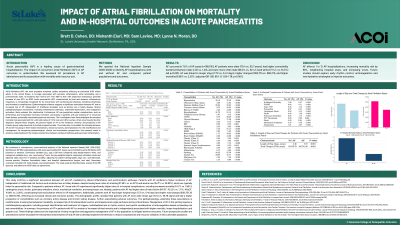
Results/Discussion: AF was present in 7.8% of AP admissions (n=168,515). Compared to those without AF, patients with AF were older (70.4 vs. 50.7 years), had higher comorbidity burdens (Charlson index 2.02 vs. 1.23), were more often male (58.3% vs. 52.4%), and more frequently white (77.4% vs. 61.3%) (all p < 0.001). AF was associated with longer hospital stays (7.72 vs. 5.47 days; p < 0.001) and higher total charges ($102,751 vs. $69,171; p < 0.001). In-hospital mortality was significantly higher among patients with AF (6.66% vs. 2.03%; P < 0.001), with a crude OR of 3.44 (95% CI, 3.28–3.62) and an adjusted OR of 1.68 (95% CI, 1.59–1.78; P < 0.001).
Conclusions: AF complicates nearly 1 in 12 AP hospitalizations and is independently associated with longer stays, increased costs, and 68% higher odds of in-hospital mortality. This excess risk likely reflects hemodynamic instability, thromboembolic potential, and the burden of systemic illness. Future prospective studies should evaluate whether early rhythm control, modified fluid resuscitation or targeted anticoagulation strategies can improve outcomes in this high-risk group.