Internal Medicine Kettering Health Dayton Dayton, Ohio, United States
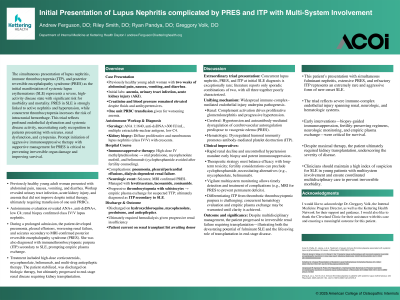
Clinical Scenario or Case: A previously healthy young adult woman with no significant medical history presented with abdominal pain, nausea, vomiting, and diarrhea. Initial evaluation revealed a urinary tract infection with associated AKI and anemia. Despite initial treatment, the patient’s blood pressure and AKI did not improve. She was ultimately transfused with one unit PRBCs and an autoimmune workup was initiated. Results were significant for ANA positivity, as well as anti-dsDNA and low C4. Kidney biopsy confirmed diffuse proliferative and membranous lupus nephritis (class IV/V). The patient was initiated on high-dose steroids alongside mycophenolate and belimumab. Due to the patient's length of hospital stay, complications such as pneumonia, effusions, renal failure, and seizures occurred. She was also placed on multi-drug antiepileptic regimen for MRI confirmed PRES. The patient was also diagnosed with ITP secondary to SLE leading to empiric plasma exchange. Patient was eventually discharged on biologic agents and ultimately required kidney transportation.
Evidence/Literature Review: Review of current literature does not indicate any prior publications including a patient presenting with new onset SLE including the simultaneous triad of lupus nephritis, PRES, and ITP. These manifestations have been documented extensively when occurring individually or in various combinations at initial diagnosis, with several studies confirming PRES as the initial manifestation of SLE, often in the context of active lupus nephritis and severe hypertension.
Unique Aspects of Case: This patient's initial presentation of SLE manifesting with a simultaneous triad of fulminant nephritis, extensive PRES and refractory ITP, represents an extremely uncommon presentation that highlights the aggressive immune-complex endothelial injury across cerebral, hematologic, and renal systems.
Recommendations/Conclusions: New-onset SLE can, in rare occurrences such as this, present with life threatening complications. This case underscores the importance for physicians to maintain a high index of suspicion in young patients with multi-system organ dysfunction.