Internal Medicine Kettering Health Dayton Dayton, Ohio, United States
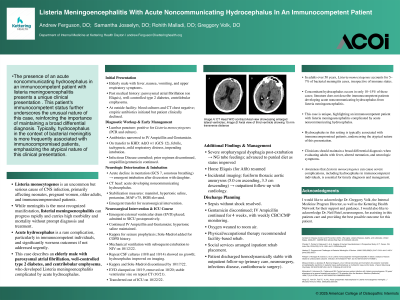
Clinical Scenario or Case: We present an elderly male with upper respiratory symptoms alongside fever, nausea, and vomiting. At that time, the patient's medical history was significant for paroxysmal atrial fibrillation, well-controlled type two diabetes, and centrilobular emphysema. Initial blood cultures and CT chest were negative, however the patient continued to decline despite empiric antibiotic therapy. Further workup included a lumbar puncture that resulted in Listeria monocytogenes positivity on PCR and culture. Antibiotic treatment was subsequently narrowed to IV Ampicillin and Gentamicin. The patient’s mentation did not show improvement with narrowing of antibiotics and ultimately required endotracheal intubation and mechanical ventilation. CT head demonstrated new onset hydrocephalus. Further treatment with mannitol, hypertonic saline, protamine, and external ventricular drain showed significant improvement in patient’s status and repeat imaging.
Evidence/Literature Review: In adults over 50 years old, with a paralleled increase in prevalence and age, Listeria monocytogenes occurs in 5-7% of bacterial meningitis cases – irrespective of immunological status. Furthermore, as only 10-15% of these cases have documented the development of concomitant hydrocephalus, this case is among this rare subclass of patients. Review of current literature has not shown any reported cases of immunocompetent individuals developing listeria meningoencephalitis with acute noncommunicating hydrocephalus.
Unique Aspects of Case: The presence of an acute noncommunicating hydrocephalus in an immunocompetent patient with listeria meningoencephalitis presents a unique clinical presentation . This patient's immunocompetent status further underscores the unusual nature of this case, reinforcing the importance of maintaining a broad differential diagnosis. Typically, hydrocephalus in the context of bacterial meningitis is more frequently associated with immunocompromised patients, emphasizing the atypical nature of this clinical presentation.
Recommendations/Conclusions: Pathogens like Listeria monocytogenes, present varying complications such as, in this case, noncommunicating hydrocephalus that may arise even in immunocompetent patients. This underscores the necessity for clinicians to maintain a broad differential when encountering adult patients with fever and neurologic symptoms.