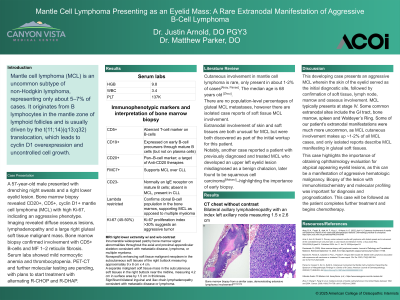
Clinical Scenario or Case: A 57-year-old male presented with drenching night sweats and a right lower eyelid lesion. Biopsy revealed CD20+, CD5+, cyclin D1+ mantle cell lymphoma (MCL) with high Ki-67, indicating an aggressive phenotype. Imaging revealed diffuse osseous lesions, lymphadenopathy and a large right gluteal soft tissue malignant mass. Bone marrow biopsy confirmed involvement with CD5+ B-cells and MF 1–2 reticulin fibrosis. Serum labs showed mild normocytic anemia and thrombocytopenia. PET-CT and further molecular testing are pending, with plans to start treatment with alternating R-CHOP and R-DHAP.
Evidence/Literature Review: Cutaneous involvement in mantle cell lymphoma is rare, only present in about 1% of cases (1). The median age is 68 years old [4]. A similar case involved a patient who presented with a lesion of the medial aspect of the right eyelid. He had this excised, but subsequently developed a lesion of the left conjunctiva, lymphadenopathy and bronchial lesions [3]. Finally, there was a case of a patient with previously diagnosed and treated MCL who developed an upper left eyelid lesion misdiagnosed as a benign chalazion, later found to be squamous cell carcinoma [2]--highlighting the importance of early biopsy.
Unique Aspects of Case: This case presents an aggressive MCL wherein the skin of the eyelid served as the initial diagnostic site, followed by confirmation of marrow and osseous involvement. MCL eyelid involvement is extremely rare, and most periorbital lymphomas are MALT-type. Additionally, a large gluteal malignant neoplasm is present and likely represents another uncommon metastatic site, underscoring the complexity and extent of the presentation.
Recommendations/Conclusions: This developing case highlights the importance of obtaining ophthalmology evaluation for atypical appearing eyelid lesions, as this can be a manifestation of aggressive hematologic malignancy. Biopsy of the lesion with immunohistochemistry and molecular profiling were critical for diagnosis and prognostication. In patients with persistent drenching night sweats of unclear etiology, imaging should be considered.