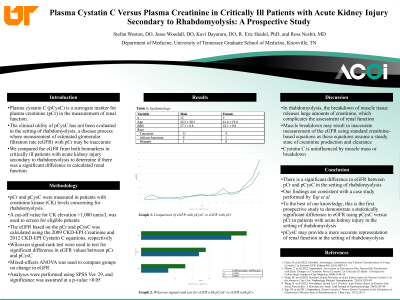
(80-RES) Plasma Cystatin C Versus Plasma Creatinine in Critically Ill Patients with Acute Kidney Injury Secondary to Rhabdomyolysis: A Prospective Study
Internal medicine University of Tennessee Medical Center Knoxville, Tennessee, United States
Introduction/Background: Plasma cystatin C (pCysC) is a surrogate marker for plasma creatinine (pCr) in the measurement of renal function. However, the clinical utility of pCysC has not been evaluated in the setting of rhabdomyolysis, a disease process where measurement of estimated glomerular filtration rate (eGFR) with pCr may be inaccurate. We compared the eGFR from both biomarkers in critically ill patients with acute kidney injury secondary to rhabdomyolysis to determine if there was a significant difference in calculated renal function.
Methods: pCr and pCysC were measured in patients with creatinine kinase (CK) levels concerning for rhabdomyolysis. A cut-off value for CK elevation >1,000 units/L was used to screen for eligible patients. The eGFR based on the pCr and pCysC was calculated using the 2009 CKD-EPI Creatinine and 2012 CKD-EPI Cystatin C equations. Wilcoxon tests were used to test for significant difference in eGFR values between pCr and pCysC, and mixed-effects ANOVA was used to compare groups on change in eGFR.
Results/Discussion: There was a significant difference in eGFR values between pCr and pCysC with a Z-score -2.25 and p-value 0.02. Our study was able to confirm our initial suspicion and discern a significant difference in eGFR between pCr and pCysC in the setting of rhabdomyolysis. Additionally, we were able to highlight a significantly smaller reduction in eGFR with pCysC as compared to pCr. To the best of our knowledge, this is the first prospective study to demonstrate a statistically significant difference in eGFR using pCysC versus pCr in patients with acute kidney injury in the setting of rhabdomyolysis.
Conclusions: pCysC may provide a more accurate representation of renal function than pCr in the setting of acute kidney injury secondary to rhabdomyolysis.