Internal Medicine Kettering Health Dayton Dayton, Ohio, United States
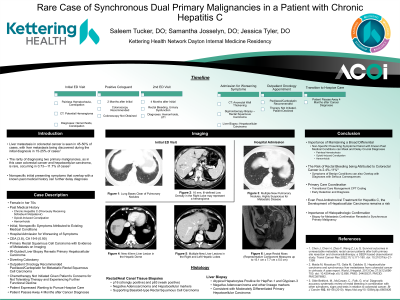
Clinical Scenario or Case: This is a case presentation of a female in her seventies with a past medical history notable for chronic hepatitis C, previously receiving sofosbuvir/velpatasvir, opioid induced constipation, and hemorrhoids, who initially presented to the emergency department for painless hematochezia and constipation. Initial imaging only revealed a potential liver hemangioma, and patient was treated for constipation. After, a positive Cologuard test resulted while outpatient. Four months later, progression to painful hematochezia and voiding dysfunction prompted a second evaluation, resulting in further treatment for constipation and outpatient gastroenterology follow up. Days later, she was admitted and diagnosed with rectal carcinoma, with evidence of metastasis. IR-guided liver biopsy for confirmation revealed an unexpected primary hepatocellular carcinoma. Chemotherapy was initiated, followed by hospice care, with the patient ultimately passing away less than four months after her cancer diagnosis.
Evidence/Literature Review: The development of liver metastasis in colorectal cancer is not a particularly unexpected finding, with this being an outcome in 45-50% of cases, with liver metastasis being discovered during the initial diagnosis in 15-25% of cases (Chen et al., 2022). However, the diagnosis of hepatocellular carcinoma on IR-guided biopsy, when confirming liver metastasis, demonstrates the rarity of diagnosing two primary malignancies, with this occurring in 0.73%-11.7% of cases (Maida et al., 2013).
Unique Aspects of Case: Repeat imaging four months after initial presentation, which only showed a potential hemangioma initially, revealed evidence of rectal carcinoma with metastasis to the liver and the lungs. Confirmatory liver biopsy resulted in the diagnosis of a previously unknown hepatocellular carcinoma, revealing synchronous dual primary malignancies.
Recommendations/Conclusions: The presentation of initial nonspecific symptoms, supported by known past medical history, highlights the importance of maintaining a broad differential when symptoms can mask and delay the diagnosis of a malignancy, as well as the importance of histopathological confirmation, which can reveal unexpected findings.