IM Resident Inspira health Belle mead, New Jersey, United States
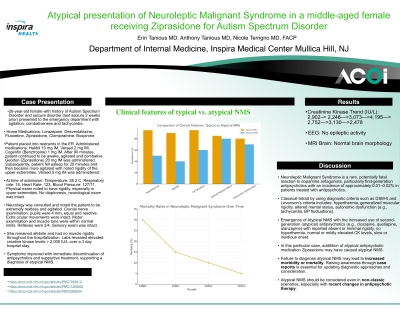
Clinical Scenario or Case: A 26-year-old female with Autism Spectrum Disorder presented with Agitation, diaphoresis, and mild tachycardia after an increased dose of Ziprasidone. Notably, she remained afebrile and had upper extremity muscle rigidity. Labs revealed elevated creatine kinase (CK > 2,000 IU/L). Despite lacking key DSM-5 criteria for NMS, her symptoms improved with immediate discontinuation of antipsychotics, supportive treatment, and Valium as needed, supporting a diagnosis of atypical NMS.
Evidence/Literature Review: Diagnostic criteria, such as Hyperthermia, Generalized muscular rigidity, Altered mental status and , Autonomic dysfunction (e.g., tachycardia, BP fluctuations) in the DSM-5 and Levenson's criteria, rely heavily on these features. which is typical to NMS . But, with the increased use of second-generation (atypical) antipsychotics, more atypical NMS cases have been reported without either Hyperthermia, rigidity or Autonomic dysfunction
Unique Aspects of Case: The patient had started a new atypical antipsychotic medication and increased the dose, who had presented without Hyperthermia but with elevated CK >3000 .
Recommendations/Conclusions: Failure to diagnose atypical NMS may lead to increased morbidity or mortality. Raising awareness through case reports is essential for updating diagnostic approaches. Atypical NMS should be considered even in non-classic scenarios, especially with recent changes in antipsychotic therapy.