Internal Medicine Canyon Vista Medical Center Sierra Vista, Arizona, United States
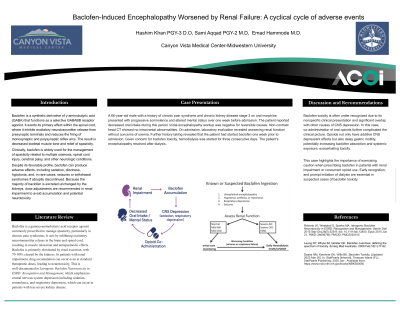
Clinical Scenario or Case: A 66-year-old male with a history of chronic pain syndrome and chronic kidney disease stage 3 on oral morphine presented with progressive somnolence and altered mental status over one week. The patient reported decreased oral intake during this period. Initial encephalopathy workup was negative for reversible causes. Non-contrast head CT showed no intracranial abnormalities. On admission, laboratory evaluation revealed worsening renal function without concerns of uremia. Further history taking revealed that the patient had started baclofen one week prior to admission. Given concern for baclofen toxicity, hemodialysis was started for three consecutive days. The patient's encephalopathy resolved after dialysis.
Evidence/Literature Review: Baclofen is a gamma-aminobutyric acid receptor agonist commonly prescribed to manage spasticity, particularly in chronic pain syndromes. It acts by inhibiting excitatory neurotransmitter release in the brain and spinal cord, resulting in muscle relaxation and antispasmodic effects. Baclofen is primarily eliminated by renal excretion, with 70–80% of the drug cleared by the kidneys. In patients with renal impairment, drug accumulation can occur even at standard therapeutic doses, leading to neurotoxicity. This is well-documented in Iatrogenic Baclofen Neurotoxicity in ESRD: Recognition and Management, which emphasizes central nervous system depression, including sedation, somnolence, and respiratory depression, which can occur in patients with less severe kidney disease.
Unique Aspects of Case: Baclofen toxicity is often underrecognized due to its nonspecific clinical presentation and significant overlap with other causes of CNS depression. In this case, co-administration of oral opioids further complicated the clinical picture. Opioids not only have additive CNS depressant effects but also delay gastric motility, potentially increasing baclofen absorption and systemic exposure, exacerbating toxicity.
Recommendations/Conclusions: This case highlights the importance of exercising caution when prescribing baclofen in patients with renal impairment or concurrent opioid use. Early recognition and prompt initiation of dialysis are essential in suspected cases of baclofen toxicity.