Internal Medicine University of the Incarnate Word School of Medicine Laredo, Texas, United States
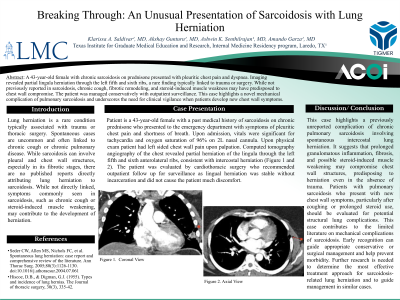
Clinical Scenario or Case: Patient is a 43-year-old female with a past medical history of sarcoidosis on chronic prednisone who presents to the emergency department with symptoms of pleuritic chest pain and shortness of breath. Upon admission, vitals were significant for tachycardia and oxygen saturation of 96% on 2L nasal cannula. Physical exam showed tenderness on palpation to the left anterior chest wall. Computed tomography angiography of the chest revealed partial herniation of the lingula through the left fifth and sixth anterolateral ribs, consistent with intercostal herniation. Patient was evaluated by cardiothoracic surgery who recommended outpatient follow up for surveillance as lingula herniation was stable without incarceration and did not cause patient much discomfort.
Evidence/Literature Review: Lung herniation is a rare condition typically associated with trauma or thoracic surgery. Spontaneous cases are uncommon and often linked to chronic cough or chronic pulmonary disease. While sarcoidosis can involve pleural and chest wall structures, especially in its fibrotic stages, there are no published reports directly attributing lung herniation to sarcoidosis. While not directly linked, symptoms commonly seen in sarcoidosis, such as chronic cough or steroid-induced muscle weakening, may contribute to the development of herniation.
Unique Aspects of Case: This case highlights a previously unreported complication of pulmonary sarcoidosis involving spontaneous intercostal lung herniation. It suggests that prolonged granulomatous inflammation, fibrosis, and possible steroid-induced muscle weakening may compromise chest wall structures, predisposing to herniation even in the absence of trauma.
Recommendations/Conclusions: Patients with pulmonary sarcoidosis who present with new chest wall symptoms, particularly after coughing or prolonged steroid use, should be evaluated for potential structural lung complications. This case contributes to the limited literature on mechanical complications of sarcoidosis. Early recognition can guide appropriate conservative or surgical management and help prevent morbidity. Further research is needed to determine the most effective treatment approach for sarcoidosis-related lung herniation and to guide management in similar cases.