Internal Medicine Jefferson Health Northeast Philadelphia, Pennsylvania, United States
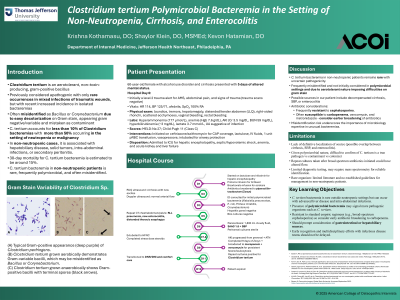
Clinical Scenario or Case: A 60-year-old female with a medical history of alcohol use disorder complicated by cirrhosis presented after five days of worsening altered mental status. She was found to have hyperammonemia, acute kidney and liver failure, and gastrointestinal bleeding. Initial CT scan of chest/abdomen/pelvis had no acute pathology. She was aggressively treated for septic/hypovolemic shock, hepatic encephalopathy, and required intubation for airway protection. Initial blood cultures were polymicrobial with Klebsiella pneumoniae, E. coli, Proteus mirabilis, and Corynebacterium, concerning for an intra-abdominal source. Blood cultures two days later grew only C. tertium. BAL, urine, and peritonitic cultures remained sterile. Peritoneal fluid analysis revealed signs of SBP. She had repeat imaging on hospital day five which showed new enterocolitis. She ultimately died after transition to comfort care on hospital day 12.
Evidence/Literature Review: C. tertium bacteremia in non-neutropenic patients is a rare phenomenon with poorly understood pathogenesis. When present, it is more likely to be polymicrobial and occur in those with hepatobiliary infections or disease, hematologic or tumor malignancies, and secondary peritonitis. The bacteria are aerotolerant, non-toxin-producing, and Gram-positive bacillus that are easily misidentified as Gram-negative organisms such as Bacillus or Corynebacterium due to easy decolorization during gram staining. When polymicrobial bacteremia is present, C. tertium may be a marker for more virulent organisms.
Unique Aspects of Case: In non-neutropenic patients, polymicrobial bacteremia inclusive of C. tertium is rare. Although she had sterilization of other culture sources, our patient may have developed C. tertium bacteremia as a result of decompensated cirrhosis, SBP, or enterocolitis.
Recommendations/Conclusions: C. tertium has unique antibiotic resistance to typical broad spectrum cephalosporins, may be thought of as a commensal gastrointestinal organism with unclear significance in certain infections, and poses a difficulty during microbiological identification given its aerotolerance. Identification of this organism in non-neutropenic patients should prompt an investigation into gastrointestinal sources.