(51-RES) Case report on a rare presentation of babesiosis induced liver failure and hemolytic anemia presenting as conjugated (direct) hyperbilirubinemia.
Internal Medicine Inspira Health Network Glassboro, New Jersey, United States
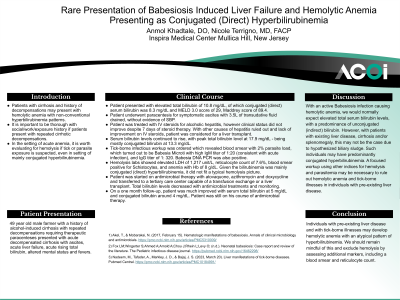
Clinical Scenario or Case: A 49-year-old male with alcohol-induced cirrhosis presented with fevers, abdominal distension, and altered mental status. He was admitted for acutely decompensated cirrhosis with ascites and acute liver failure. His total bilirubin rose to 17.9 mg/dL, predominantly conjugated (13 mg/dL). Given recent alcohol use and a high Maddrey score, IV steroids were initiated for suspected alcoholic hepatitis, but there was no improvement after seven days.
CT imaging showed cirrhosis and portal hypertension without biliary obstruction. With worsening liver function and no steroid response, liver transplant evaluation was pursued. Due to his history of farm work, a tick-borne disease workup was done and revealed Babesia microti infection (positive smear, PCR, IgM 1:20, IgG 1:320). Labs showed anemia (Hb ~8), LDH 1,217, schistocytes, and elevated reticulocytes (7.6%), indicating hemolysis, though the bilirubin pattern was conjugated.
He was started on atovaquone, azithromycin, and doxycycline. Fortunately, bilirubin levels began downtrending without exchange transfusion or transplant. He was discharged on antimicrobials and, at one-month follow-up, showed clinical improvement with total bilirubin down to 5 mg/dL.
Evidence/Literature Review: There have been only a few documented cases of babesiosis-related hemolytic anemia presenting as conjugated hyperbilirubinemia. It has been hypothesized that people with existing liver disease/cirrhosis or severe/long standing babesiosis may develop biliary sludge which may be the etiology for the predominantly conjugated hyperbilirubinemia.
Unique Aspects of Case: In patients with existing cirrhosis, Babesiosis-induced hemolysis may present with predominantly conjugated bilirubinemia. Thus, relying solely on bilirubin type can be misleading, and evaluation using hemolysis markers and parasitemia testing is essential to diagnose hemolytic anemia and parasitemia in this population.
Recommendations/Conclusions: In patients with cirrhosis, tick-borne hemolysis may show atypical bilirubinemia. A more focused workup is warranted in such individuals.