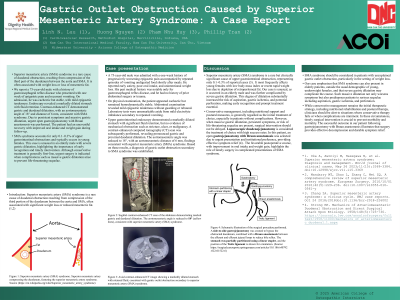
Clinical Scenario or Case: A 75-year-old male presented with one week of epigastric pain and repeated vomiting of undigested food. He had a history of gastroesophageal reflux disease without prior surgery. On admission, he was cachectic but hemodynamically stable, with mild epigastric tenderness. Endoscopy revealed a dilated stomach with fluid retention. Contrast-enhanced CT showed marked gastric and duodenal dilatation with an aortomesenteric angle of 18° and distance of 6 mm, consistent with superior mesenteric artery syndrome. A diagnosis of gastric outlet obstruction secondary to SMA syndrome was made. Urgent surgical intervention was performed, including gastrojejunostomy (side-to-side) with Braun anastomosis. The patient had an uneventful postoperative recovery and was discharged with improved oral intake and weight gain during follow-up.(1,2)
Evidence/Literature Review: Superior mesenteric artery (SMA) syndrome is a rare cause of duodenal obstruction resulting from compression of the third portion of the duodenum between the aorta and SMA, often associated with significant weight loss or reduced mesenteric fat.
Unique Aspects of Case: SMA syndrome is a rare but significant cause of upper gastrointestinal obstruction, accounting for only 0.1–0.3% of cases (3). It commonly affects young females; however, our case is unique because it occurred in an elderly male and was complicated by severe gastric dilatation, increasing the risk of gastric perforation and aspiration. These features highlight the importance of early recognition and aggressive intervention in complicated cases. Although conservative management is usually the first-line treatment, urgent surgical intervention should be considered when complications such as massive gastric dilatation occur, as delay may lead to life-threatening sequelae. In this case, an open gastrojejunostomy with Braun anastomosis was performed, ensuring effective decompression and bypass of the obstructed duodenum.(4)
Recommendations/Conclusions: Superior mesentery artery syndrome is a life threatening disease. It should be treated as soon as possible. Conservative trial can be given but Surgery is the treatment of the choice.