Internal Medicine Western Michigan University Homer Stryker M.D. School of Medicine kalamazoo, Michigan, United States
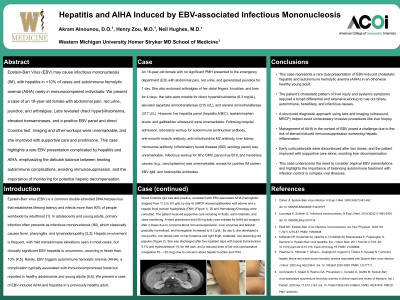
Clinical Scenario or Case: An 18-year-old female with early satiety and fecal urgency presented with 1 day of abdominal pain, red urine, and jaundice. She also endorsed diffuse pain and arthralgias in her distal fingers, knuckles, and toes for 4 days. Labs revealed direct hyperbilirubinemia (8.3 mg/dL) and elevated transaminases (AST 215 U/L, ALT 317 U/L). Hepatitis panel, acetaminophen level, and gallbladder ultrasound were unremarkable. Further workup showed positive infectious mononucleosis screen, EBV IgM, and heterophile antibodies. Direct Coombs IgG was positive, indicating EBV-associated AIHA. She received supportive care and brief corticosteroids (prednisone 40 mg), which were discontinued due to immunosuppression concerns.
Evidence/Literature Review: Epstein-Barr Virus (EBV) is a double-stranded DNA herpesvirus that infects over 90% of the global population by adulthood. Though often asymptomatic in children, EBV may induce infectious mononucleosis (IM) in young adults, causing fever, pharyngitis, and lymphadenopathy. EBV-induced hepatitis occurs in < 10% of cases, while EBV-induced autoimmune hemolytic anemia (AIHA) rarely presents in immunocompetent patients. We present a case of EBV-induced AIHA and hepatitis in a previously healthy young adult.
Unique Aspects of Case: This case highlights a rare and clinically complex presentation of EBV infection complicated by hepatitis and autoimmune hemolytic anemia (AIHA). The patient’s initial jaundice, red urine, and elevated bilirubin raised concern for biliary obstruction or drug-induced liver injury. However, serologies and imaging clarified the diagnosis, avoiding invasive procedures. Liver involvement in EBV is typically mild; here, atypical features mimicked autoimmune hepatitis. Treating AIHA without worsening EBV hepatitis posed a therapeutic challenge.
Recommendations/Conclusions: This case underscores the importance of considering EBV in jaundiced young adults and balancing autoimmune and infectious management. Steroid use, while helpful for AIHA, may worsen EBV-related inflammation through immunosuppression. Close monitoring and thoughtful specialist involvement are essential to prevent hepatic decompensation. Recognizing this rare overlap can guide more accurate, less invasive, and safer care.