Internal Medicine Palmetto General Hospital Boynton Beach, Florida, United States
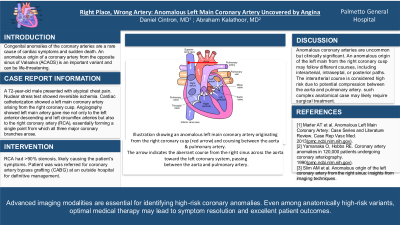
Clinical Scenario or Case: A 76-year-old male with hypertension and type 2 diabetes presented with exertional chest pain. A nuclear stress test showed reversible ischemia, and he was admitted for cardiac catheterization. During left heart catheterization, the left main coronary artery was found to originate anomalously from the right coronary cusp. Angiography revealed the left main artery gave rise to the left anterior descending, left circumflex, and right coronary arteries—forming a single origin for all major branches. A critical (>90%) stenosis was found in the RCA, believed to be the cause of symptoms. The patient was referred for CABG at an outside hospital.
Evidence/Literature Review: Anomalous origin of the left main coronary artery (LMCA) from the right coronary cusp is rare, with a reported prevalence of 0.03%–0.15% in angiographic studies. This variant is especially concerning when the LMCA courses between the aorta and pulmonary artery, increasing the risk of ischemia or sudden cardiac death. Shared-origin anomalies with stenosis warrant close evaluation and often surgical intervention.
Unique Aspects of Case: Coronary artery anomalies are rare congenital variations, present in under 1% of the population. While often incidental, some variants have significant clinical implications, especially when they predispose to ischemia or sudden cardiac death. Anomalous origin of the left main coronary artery from the right coronary cusp is uncommon and potentially dangerous. This case highlights a unique presentation identified during evaluation for exertional angina.
Recommendations/Conclusions: This case highlights the importance of identifying coronary artery anomalies, particularly in symptomatic patients. Anomalous LMCA from the right coronary cusp with a shared origin of major branches is rare and complicates diagnosis and management. Advanced imaging and early surgical consultation are recommended. CABG remains the preferred treatment when stenosis is present in complex variants to reduce cardiac event risk.