Medical Student Nova Southeastern University Dr. Kiran C. Patel College of Osteopathic Medicine Davie, Florida, United States
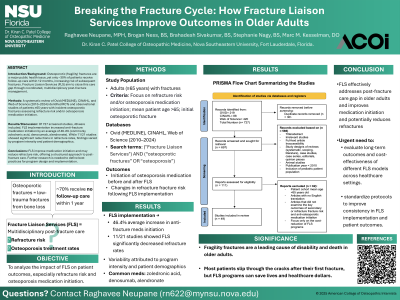
Introduction/Background: Osteoporotic fractures (fragility fractures) are fractures caused by underlying osteoporosis that occur after minimal trauma. They represent a prevalent public health problem worldwide with significant economic burden and negative effects on quality of life. Only an estimated 30% of patients who present with an osteoporotic fracture receive follow-up care within 12 months, predisposing them to subsequent fractures. Fracture Liaison Services (FLS) are multidisciplinary programs aimed to decrease secondary fractures in high-risk patients by improving the post-fracture care gap. This review analyzes the impact of FLS on patient outcomes, especially refracture risk and osteoporosis medication initiation.
Methods: This review was conducted using Ovid (MEDLINE), CINAHL, and Web of Science. RCTs, cross-sectional studies, observational studies, longitudinal studies, and cohort prospective/retrospective studies published between 2010-2024 were included. Selected articles also had a focus on refracture risk and/or osteoporotic medication initiation, a patient cohort mean age greater than 65 years old, and patients presenting with an initial osteoporotic fracture (as opposed to a history of fractures).
Results/Discussion: Out of 727 total articles screened, 49 were included. Implementation of FLS was consistently associated with an increase in patients starting anti-fracture medication, with an average increase of 46.4% post-FLS implementation. The most commonly prescribed medications were zoledronic acid, denosumab, and alendronate. FLS implementation was generally associated with a decrease in refracture rate but only 11 out of 21 studies that assessed this found a statistically significant difference. Variability in refracture rates among studies may be due to differences in program intensity and patient demographics (namely age and level of function).
Conclusions: FLS can be an effective model to target the post-fracture care gap in older osteoporosis patients and improve outcomes, particularly medication initiation. Future studies should further evaluate best practices for FLS programs.